




Title: When Something Breaks, It Breaks Many
Date: 2026, Technique: Stop motion, Poem, Paper Mache structures, Table.
Dimensions: Variable
Location: Jedna Dva Tři Gallery, Prague
Curatorial text by Šárka Koudelová for the exhibition ‘SWAMP DESIRES’
When Something Breaks, It Breaks many begins with the urban pigeon: a bird that is increasingly treated by municipalities as a problem an organism that occupies buildings, damages monuments, contaminates surfaces, and disrupts the imagined order of the city. Yet the pigeon’s presence in the city is itself a consequence of human histories. Descended largely from birds bred, domesticated, and released by humans, pigeons have learned to inhabit the architecture that has replaced their earlier habitats. What was once a cliff becomes a building; a ledge becomes a home.
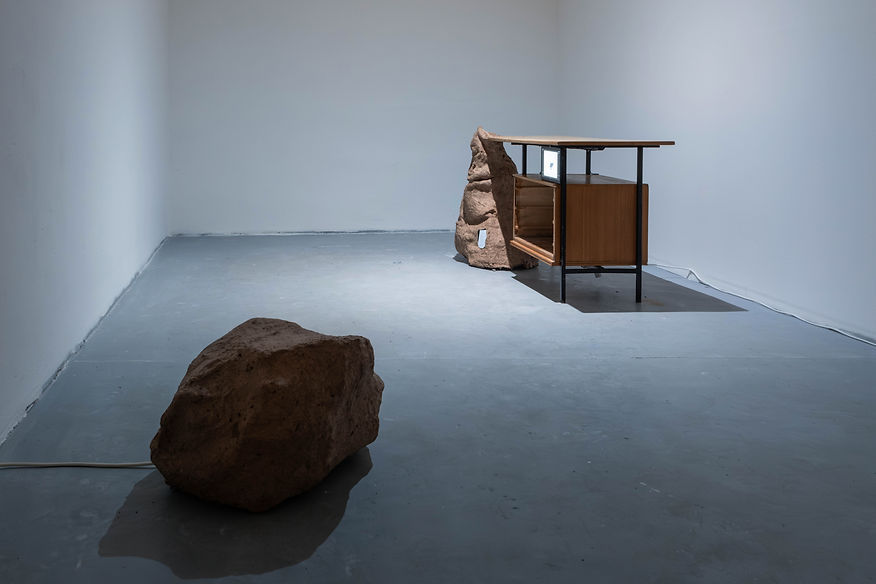
In the work, a stop-motion animation of a pigeon is placed directly on a table. The pigeon moves, eats, and gradually becomes divided, its body slowly cut into two. Alongside it, at a distance, another animation follows a potted plant as it falls from its elevated position towards the ground, over a rough rock-like structure. These movements suggest forms of displacement, adaptation, collapse, and the unstable idea of where something belongs.
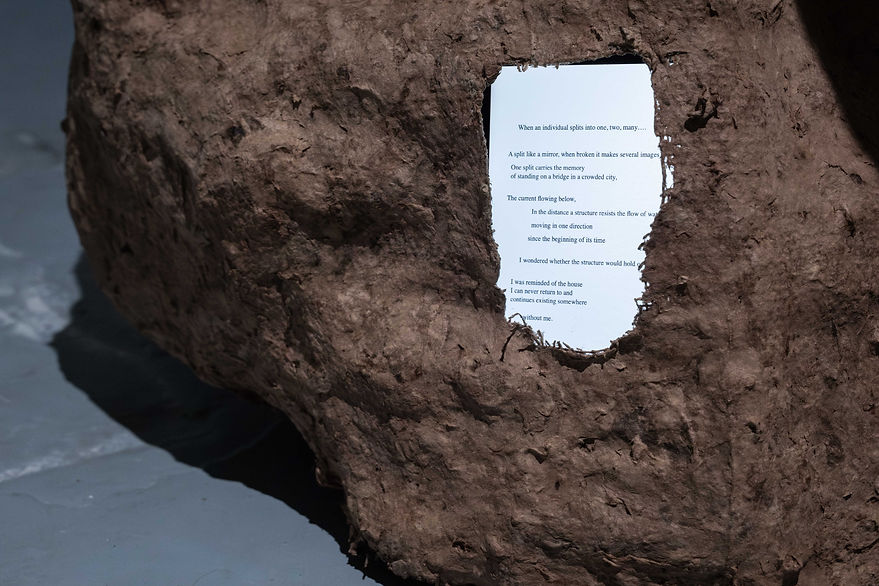
The table is important. It evokes the bureaucratic space through which land, property, ownership, habitation, and belonging are organised and controlled. On this surface, an organic, earth-like form slowly spreads, consumes, and takes over the table itself. A poem is embedded within this structure, beginning with the possibility that when an individual splits, it does not simply become two, but many. The broken mirror becomes a figure for memory: each fragment carrying something of the original while also becoming something else.
The pigeon, the plant, the rock, the table, and the expanding organic form consequently occupy an uncertain territory between living and non-living, nature and infrastructure, home and dispossession. Rather than opposing these forces, the work allows them to overlap to suggest that when something breaks, it does not simply disappear. It produces several other forms, memories, and ways of inhabiting.